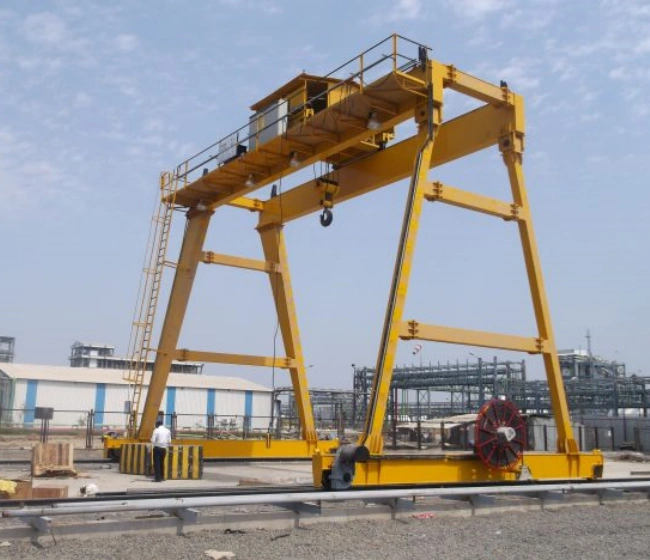
What Is the Standard Lift Height for an Overhead Crane? A Complete Guide for Buyers
When sourcing an overhead crane for your facility, one of the most critical specifications you will encounter is lift height. Many buyers ask: “What is the standard lift height for an overhead crane?”
The short answer is: there is no single universal standard. However, industry norms, common design configurations, and regulatory guidelines do exist. Understanding these will help you avoid costly mistakes, improve safety, and ensure your crane fits your building’s exact dimensions.
In this guide, we’ll break down typical lift heights, key factors that influence them, and how to determine the right height for your application.
What Does “Lift Height” Mean for an Overhead Crane?
First, let’s clarify the definition. Lift height (also called hook height) is the maximum vertical distance the crane hook can travel from its lowest point (usually ground level or the floor) to its highest position under normal operation.
It is not the same as:
Headroom: The vertical space from the crane runway rail to the roof or ceiling.
Under-hook height: Typically measured from the floor to the crane hook at its highest position.
Understanding this distinction is essential before comparing crane specifications.
Typical Standard Lift Height Ranges
While custom cranes can be built to almost any dimension, manufacturers commonly offer standard lift heights based on decades of industrial applications. The most frequently encountered lift heights include:
10 feet (3 meters): Common for light-duty workstations, jib cranes, and low-ceiling workshops.
15–20 feet (4.5–6 meters): Standard for many single-girder overhead cranes in warehouses and small manufacturing plants.
25–30 feet (7.6–9 meters): Widely used in mid-sized fabrication shops, steel service centers, and general assembly lines.
35–40 feet (10.7–12.2 meters): Typical for double-girder cranes in heavy industry, foundries, and large distribution centers.
50+ feet (15+ meters): Custom applications – power plants, shipyards, and high-bay storage facilities.
👉 Industry benchmark: For a standard 5-ton to 20-ton overhead crane with a single girder, 20 to 25 feet (6–7.6 meters) is the most commonly quoted “standard” range.
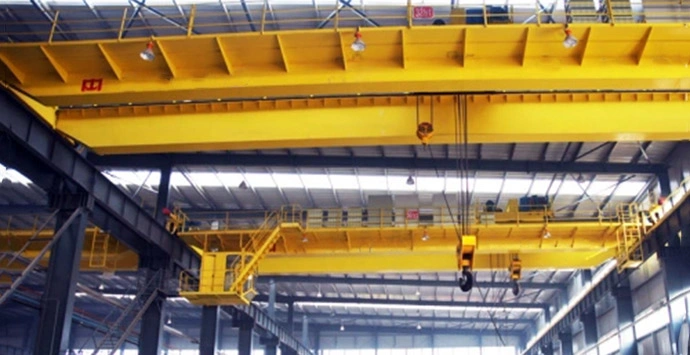
Why No Single Standard Exists
Several variables prevent a one-size-fits-all lift height:
1. Building Structure
Your facility’s eave height and roof truss design directly limit maximum lift height. If your building has a 30-foot eave height, your crane’s hook height will typically be 4–6 feet lower due to crane girder depth, trolley clearance, and hoist dimensions.
2. Crane Classification (CMAA or FEM)
Heavy-duty cranes (CMAA Class D, E, or F) often require double girders, which increase overall crane height, reducing available lift height compared to a single-girder design in the same building.
3. Hoist Type
Wire rope hoists: Generally require more headroom but offer higher lift heights.
Chain hoists: Compact but limited to shorter lifts (typically under 30 feet for standard models).
4. End Trucks and Runway
Low-profile end trucks can gain you an extra 6–12 inches of lift height. This is a common engineering adjustment when working with low ceilings.
How to Calculate the Optimal Lift Height for Your Overhead Crane
Instead of memorizing a “standard,” use this formula:
Maximum Lift Height = Building Eave Height – (Crane Girder Depth + Trolley Height + Hoist Deadband + Safety Clearance)
Let’s break it down with an example:
Building eave height: 30 ft
Crane girder depth: 2 ft (typical single girder for 10-ton crane)
Trolley height: 1.5 ft
Hoist deadband (distance from hook to hoist frame): 1 ft
Safety clearance (OSHA/CMAA recommended): 1.5 ft
Lift height = 30 – (2 + 1.5 + 1 + 1.5) = 24 ft
In this case, your usable lift height is 24 feet, not the building’s full 30 feet.
Common Industry Standards and Regulations
While no single lift height is mandated worldwide, several standards influence typical designs:
CMAA Specification 70 (USA): Provides guidelines for top-running and under-running cranes, including minimum headroom and lift height calculations.
FEM (Europe) and ISO 4301: Specify crane groups and clearances but not a fixed lift height.
OSHA 1910.179: Requires sufficient lift height to avoid load contact with obstructions, but does not define a specific number.
For most general-purpose cranes under 20 tons, CMAA recommends a minimum hook height of 20 feet for efficient material handling, but this is a guideline, not a requirement.
When to Choose More Than “Standard” Lift Height
Many buyers opt for extra lift height even if not immediately needed. Consider increasing your specification if:
You plan to stack storage racks or vertical storage systems.
Future building renovations may raise the roof (e.g., adding a monitor roof).
Your production process involves tall machinery or large molds.
You may switch to larger lifting beams or spreader bars (which reduce effective hook height).
A common rule among crane engineers: Specify 2–3 feet of additional lift height if your budget and building allow it. It’s far cheaper to add during initial installation than to modify later.
Low Headroom vs. High Lift Cranes
Two specialized configurations push beyond standard ranges:
Low Headroom Cranes
Designed for buildings with limited eave height (e.g., 12–16 ft). These use compact hoists and specially profiled end trucks to achieve 8–12 ft of lift height where a standard design would yield only 4–5 ft.
High Lift Cranes
Used in shipbuilding, wind tower manufacturing, or warehouse mezzanines. Lift heights of 60–100+ feet are possible with multi-part reeving and deep building sections. These are always custom-engineered.
Cost Implications of Non-Standard Lift Height
Sticking to a “standard” lift height (e.g., 20 or 25 ft) typically means:
Shorter lead times (off-the-shelf components)
Lower purchase price (no special engineering)
Easier future replacement parts
Deviating significantly from standard ranges (e.g., 45 ft lift height) adds cost for:
Longer wire rope or load chain
Taller crane girders or reinforced end trucks
Larger hoist drums and reeving systems
Expect a 10–30% premium for non-standard lift heights above 40 feet.
Final Verdict: What Is the Standard Lift Height?
If you need a single number for budgeting or initial planning, 20 to 25 feet (6–7.6 meters) is the de facto standard lift height for most single-girder overhead cranes up to 20 tons capacity.
However, the correct lift height for your operation depends entirely on your building dimensions, load type, and future needs.
Always request a detailed crane layout drawing from a reputable manufacturer. Provide them with your building eave height, column spacing, and desired hook approach. A professional supplier will calculate the practical maximum lift height – not just a theoretical “standard.”
What Size Overhead Crane Do I Need for a 10 Ton Load?